Key Takeaways
- The mole is simply a counting unit. Just as a "dozen" means 12, a "mole" means 6.02 x 10²³ particles. It is not a difficult concept once you see it this way.
- Three core equations underpin all quantitative chemistry. Moles = Mass / Mr, Concentration = Moles / Volume, and stoichiometric mole ratios from balanced equations.
- Moles connect to almost every other topic. Titrations, electrolysis, energy changes, percentage yield, and atom economy all depend on the mole.
- Common errors are predictable and avoidable. Forgetting the cm3 to dm3 conversion, using Ar instead of Mr, and rounding too early are the mistakes that cost students the most marks.
Contents
For many Year 10 and Year 11 students, the mole is the single most intimidating concept in GCSE Chemistry. It feels abstract, mathematical, and disconnected from the rest of the subject. But here is the truth: the mole is simply a counting unit, and once you understand it, the rest of quantitative chemistry falls into place.
This guide breaks down the mole from first principles, walks through every core calculation with fully worked examples, and shows how this one concept threads through almost every major topic on the AQA specification.
What is a Mole?
To master quantitative chemistry, we first need to strip away the mystique. The mole is a unit of measurement used for counting particles. That is all it is.
The Power of Analogy
Human society uses specific words to represent numerical quantities because it makes communication efficient. A "pair" always represents exactly 2 items. A "dozen" refers to 12 items. A "ream" of paper is exactly 500 sheets. The term "mole" functions in exactly the same way: it is a label that stands for a specific, universally agreed-upon number.
The Scale of the Small
We need such an astronomically large number because atoms are infinitesimally small. To illustrate this scale: if you had a mole of standard textbooks and laid them flat, the stack would cover the entire landmass of the United States to a depth of roughly 320 kilometres.
Avogadro's Constant
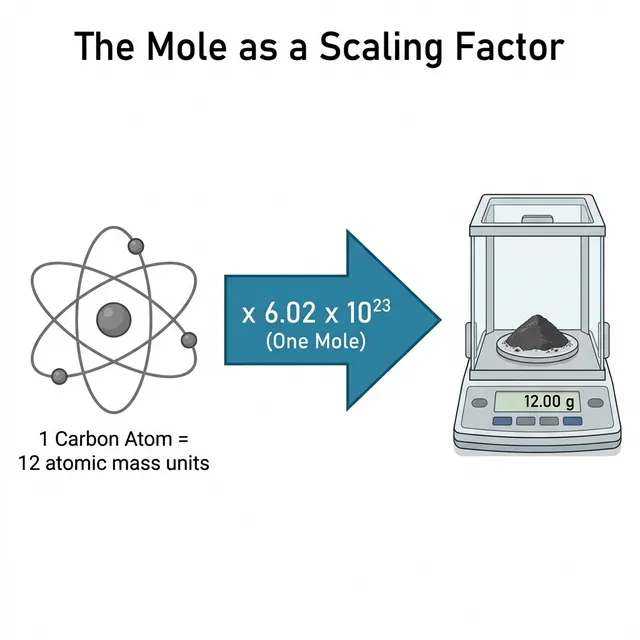
The specific numerical value assigned to the word "mole" is known as Avogadro's constant, which is exactly 6.02 x 10²³ per mole. This number was chosen for a very elegant reason.
Ar and Mr
Relative Atomic Mass (Ar) is the larger number shown for each element on the Periodic Table. It represents a weighted average mass of all the isotopes of that element.
Relative Formula Mass (Mr) refers to the total mass of a molecule or compound, calculated by adding the relative atomic masses of every atom present in the formula.
The fundamental rule of quantitative chemistry is this: the mass of exactly one mole of any substance, measured in grams, is numerically identical to its Ar or Mr. One mole of carbon (Ar = 12) has a mass of 12 g. One mole of water (Mr = 18) has a mass of 18 g. This elegant relationship is why chemists can weigh out exactly one mole of a substance on a digital balance, instead of trying to physically count 6.02 x 10²³ particles.
The Three Core Mole Calculations
Mastery of these three calculations is essential for securing high marks in quantitative chemistry. Each one follows a repeatable, step-by-step sequence.
Calculation 1: Moles, Mass, and Mr
The core equation linking theoretical amounts to physical mass is:
Moles = Mass / Mr
The mass in this equation must always be entered in grams.
Worked Example 1: Calculating moles from mass
Calculate the number of moles in a 2.64 g sample of solid sucrose, C12H22O11.
Worked Example 2: Calculating mass from moles
What is the mass of 0.250 moles of pure zinc (Zn)?
Calculation 2: Concentration of Solutions
Concentration describes the number of moles of a solute dissolved in a specific volume of solvent:
Concentration (mol/dm3) = Moles / Volume (dm3)
Critical Conversion
Volume must always be in dm3. To convert from cm3 to dm3, divide by 1000. For example, 25.0 cm3 = 0.025 dm3. Forgetting this step inflates your answer by a factor of 1000.
Worked Example 3: Calculating concentration
100 g of potassium chloride (KCl) is dissolved in 200 dm3 of distilled water. Calculate the concentration.
Worked Example 4: Calculating moles from concentration and volume
Calculate the number of moles of sodium hydroxide (NaOH) in 25.0 cm3 of a 0.100 mol/dm3 solution.
Calculation 3: Using Mole Ratios from Balanced Equations
A balanced chemical equation is a stoichiometric recipe. The large numbers (coefficients) in front of each formula tell you the precise molar ratio in which substances react.
Worked Example 5: Identifying the mole ratio
In the equation Mg(s) + 2HCl(aq) → MgCl2(aq) + H2(g), the ratio of magnesium to hydrochloric acid is 1:2. This means if you have 0.5 moles of Mg, you need exactly 1.0 mole of HCl to react completely.
Worked Example 6: Calculating reacting masses
Calculate the mass of oxygen gas (O2) required to react completely with 64.0 g of methanol (CH3OH) according to: 2CH3OH + 3O2 → 2CO2 + 4H2O.
How Moles Connect Across the Syllabus
The mole is not an isolated topic. It is the mathematical language that underpins multiple major areas of the AQA GCSE specification. Mastering it once means you can apply it everywhere.
Topics That Depend on the Mole
Titrations (Topic 3)
Finding the unknown concentration of an acid or alkali requires combining concentration calculations with stoichiometric mole ratios in a single problem.
Electrolysis (Topic 4)
Moles describe the transfer of electrons. In 2H+ + 2e- → H2, two moles of electrons produce one mole of hydrogen gas.
Energy Changes (Topic 5)
Molar enthalpy change is expressed in kJ/mol, linking directly to the energy needed to break one mole of specific covalent bonds.
Yield and Atom Economy (Topic 3)
Percentage yield depends on theoretical mole calculations. Atom economy uses Mr values to measure how efficiently atoms become useful product.
For a full breakdown of revision planning, study techniques, and exam strategy across all topics, see our companion article: How to Pass GCSE Chemistry: The Definitive Guide.
Common Mole Calculation Mistakes
These are the errors that cost students marks every single year. Each one is entirely avoidable with practice and awareness.
Forgetting the Volume Conversion
The concentration formula strictly requires volume in dm3. Forgetting to divide cm3 by 1000 inflates your final answer by a factor of exactly one thousand. Always convert first.
Using the Wrong Mr
Students frequently confuse single atoms with diatomic gases. For equations involving chlorine gas, you must use an Mr of 71 for Cl2, not the Ar of 35.5 for a single chlorine atom.
Misusing the Mole Ratio
A common error is incorporating the balancing coefficients into the Mr calculation itself. Those large numbers in front of a formula tell you the mole ratio between substances. They must never be used when calculating the Mr of an individual substance.
Premature Rounding
Rounding intermediate values to 1 or 2 decimal places mid-calculation creates compounding errors. Keep the full number in your calculator display until you reach the final answer, then round appropriately.
For more on avoiding exam pitfalls, see our article: 10 Most Common Mistakes in GCSE Chemistry Exams.
Frequently Asked Questions
Why is it called a mole?
The concept was first introduced around 1865 by the German chemist August Wilhelm von Hofmann. He used the Latin term "moles", which translates to "a large mass", to describe macroscopic changes occurring on a scale visible to the human eye.
Do I need to memorise Avogadro's number for the exam?
The precise value is routinely provided on the supplementary data sheets supplied in the examination hall. However, you should know that the constant is 6.02 x 10²³. Having immediate recall of this number ensures a significantly smoother calculation process.
What is the difference between Ar and Mr?
Ar (Relative Atomic Mass) is used exclusively for single, individual elements and accounts for isotope abundance. Mr (Relative Formula Mass) is for molecules and compounds. It is calculated by adding together the Ar values for all atoms in the chemical formula.
How do I know which mole formula to use?
It depends entirely on the data provided in the question. If you are given a mass in grams, use Moles = Mass / Mr. If you are working with an aqueous solution and given a volume and concentration, use Concentration = Moles / Volume.
Ready to practise mole calculations?
Explore our AQA GCSE Chemistry revision notes with worked examples for every topic.
Study this topic on the go
Get active recall flashcards, notes, and topic quizzes in ChemEasy, or build your revision schedule with ChemPlan IB.